THE PACKAGING RESOURCES™ SYSTEMS FRAMEWORK
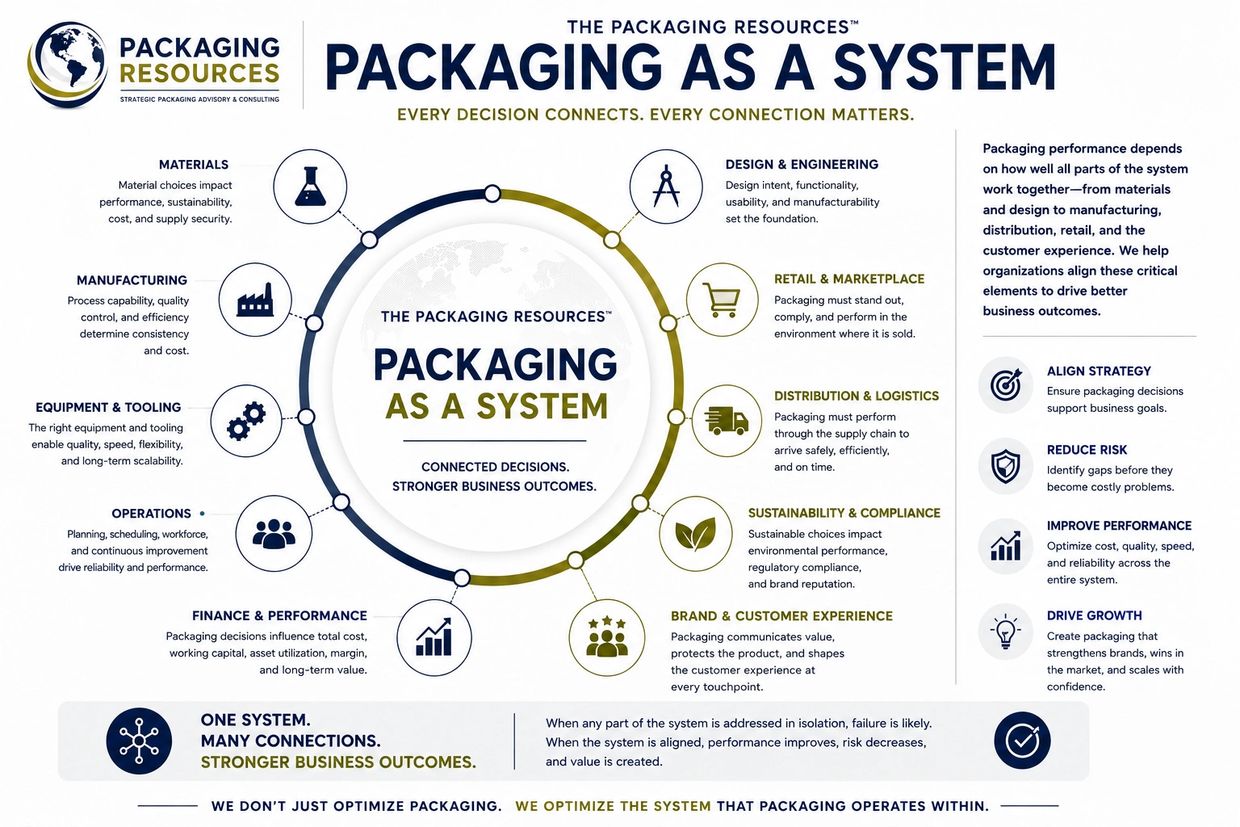
Packaging as a System
The Packaging Resources™ Systems Framework is the methodology we use to evaluate packaging as an integrated business system rather than as an isolated product, project, or department.
Most packaging problems do not originate in packaging.
They originate in fragmented decisions — where design, materials, manufacturing, equipment, sourcing, operations, retail requirements, distribution, and compliance are treated as separate conversations instead of a single system.
We approach packaging differently.
Packaging Is an Integrated System
Packaging is not a container, a graphic, or a sourcing exercise.
It is a business system that connects engineering, manufacturing, operations, distribution, retail execution, financial performance, regulatory compliance, and customer experience.
Every packaging decision creates downstream consequences. When those decisions are made independently, organizations introduce unnecessary cost, risk, delays, and operational inefficiencies.
The Packaging Resources™ Systems Framework views packaging as a connected operating system—because improving one component without understanding the entire system often creates larger problems elsewhere.
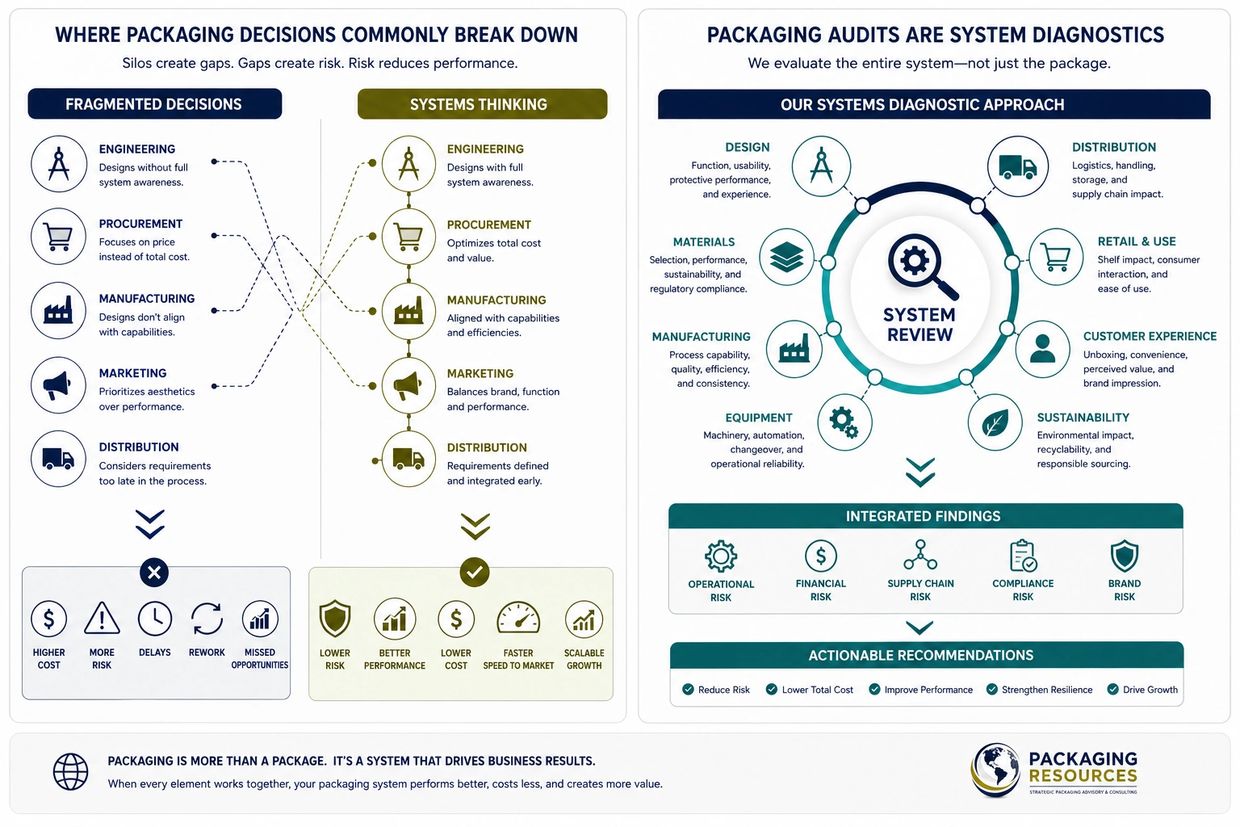
Where Packaging Decisions Commonly Break Down
Packaging failures rarely begin with bad packaging.
They begin when organizations optimize individual decisions instead of the entire system.
Typical examples include:
• Engineering designs products that manufacturing cannot efficiently produce.
• Procurement reduces material cost while increasing logistics expense.
• Marketing specifies packaging that creates operational complexity.
• Distribution requirements are considered after production has already been designed.
• Sustainability initiatives unintentionally increase cost or reduce performance.
Each decision may appear correct on its own.
Collectively, they create a system that underperforms.
Why Systems Thinking Changes Outcomes
Organizations that consistently outperform competitors rarely make better packaging decisions.
They make better systems decisions.
By evaluating how packaging interacts with manufacturing capability, equipment, supply chain, merchandising, financial performance, sustainability, and customer experience, businesses uncover opportunities that isolated departments cannot see.
The result is lower risk, improved margins, stronger operational performance, and more resilient supply chains.
Packaging becomes a strategic business asset instead of a procurement activity.
Design, Manufacturing, and Equipment Are Inseparable
Packaging decisions cannot be separated from the systems that produce, fill, seal, label, transport, display, and use them.
A design that looks right on paper can fail if it does not align with material behavior, equipment capability, manufacturing tolerances, labor requirements, speed, quality control, and distribution conditions.
That is why Packaging Resources evaluates design, manufacturing, and equipment together. The goal is not simply to create a package that looks appropriate, but to ensure the entire packaging system can be produced, scaled, distributed, and used successfully.
When design, manufacturing, and equipment are aligned early, organizations reduce costly redesigns, launch delays, quality issues, and operational failures.
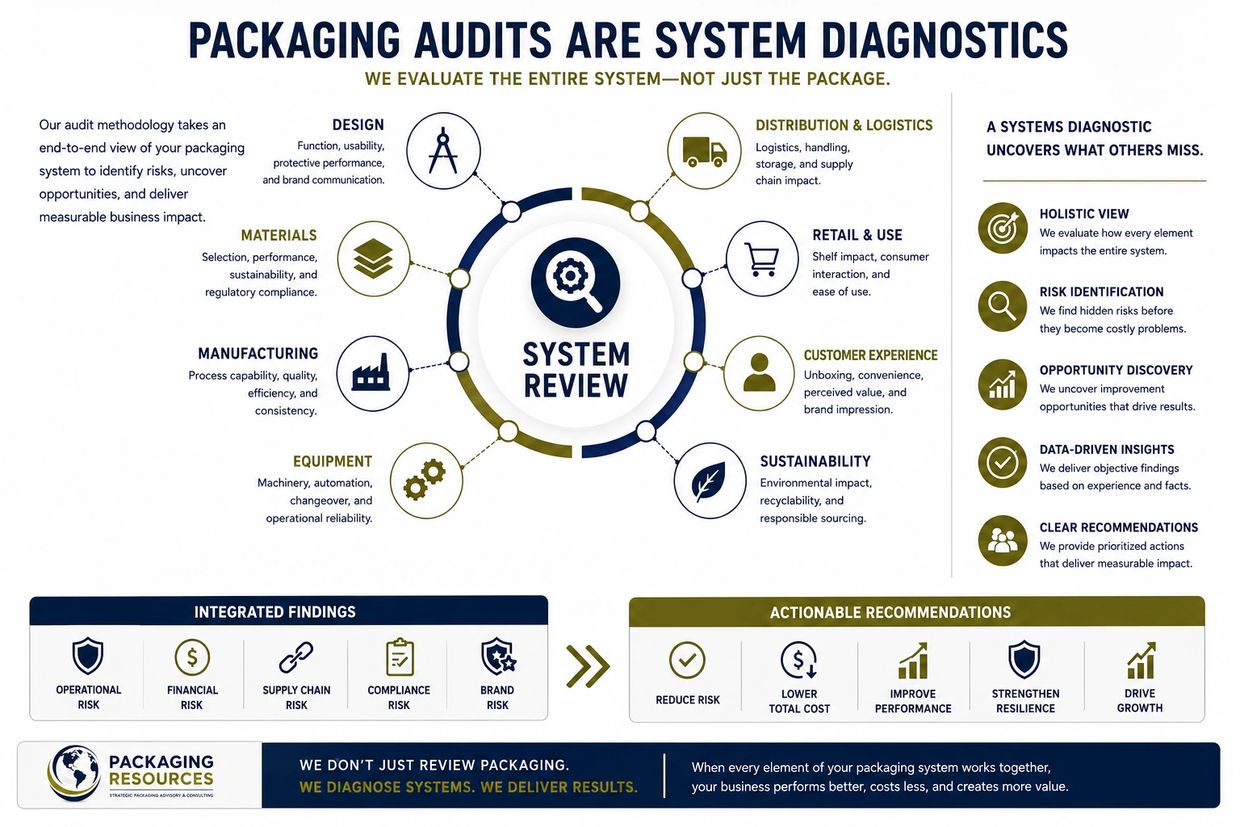
Packaging Audits as System Diagnostics
Most packaging audits evaluate specifications.
We evaluate systems.
Our methodology identifies how decisions made in one area influence performance throughout the organization.
Rather than asking whether a package complies with a specification, we determine whether the entire packaging system supports the company's operational, financial, and strategic objectives.
This often reveals opportunities that traditional packaging reviews overlook.
Why This Matters to Executives and Investors
Senior leadership is rarely concerned with packaging itself.
They are concerned with profitability, scalability, execution risk, customer experience, and return on investment.
Packaging influences every one of those outcomes.
Viewing packaging through a systems framework enables executives to make better strategic decisions, prioritize capital investments, reduce operational risk, and improve long-term enterprise value.
How This Informs Our Advisory Work
Every engagement begins by understanding the entire operating system.
Whether supporting a manufacturer, consumer brand, retailer, private equity firm, or foodservice organization, we evaluate how packaging decisions interact with the broader business.
That systems perspective enables Packaging Resources™ to identify risks, uncover opportunities, and develop recommendations that produce measurable business results—not simply better packaging.
Packaging Decisions Deserve Systems-Level Thinking
Every organization makes packaging decisions.
Few evaluate how those decisions interact across the entire business.
The Packaging Resources™ Systems Framework was developed to help organizations move beyond isolated packaging decisions and evaluate the complete operating system—from design and manufacturing to distribution, financial performance, customer experience, and long-term enterprise value.
Whether you are launching a new product, optimizing an existing packaging portfolio, evaluating an acquisition, or reducing operational risk, systems thinking provides a clearer path to better decisions.
Ready to Evaluate Your Packaging System?
Packaging is rarely the problem.
Disconnected decisions are.
If your organization is facing rising costs, operational inefficiencies, supply chain challenges, sustainability initiatives, or growth opportunities, we can help you evaluate the complete system and identify practical, measurable improvements.
Learn how the Packaging Resources™ Systems Framework can help your organization make better packaging decisions.
The Packaging Resources™ Systems Framework
The Packaging Resources™ Systems Framework is the proprietary methodology developed by Eric Faber through more than 35 years of experience advising packaging manufacturers, consumer brands, foodservice organizations, distributors, retailers, and investors. It provides a structured approach for evaluating packaging as an integrated business system rather than as an isolated product or department.
Institutional and portfolio-level advisory is provided through The Consultancy LLC.-LEARN MORE
Copyright © 2026 Packaging Resources - All Rights Reserved.
PACKAGING RESOURCES is a division of THE CONSULTANCY, LLC