The Packaging Resources™ Systems Framework
For decades, packaging decisions have been treated as isolated technical projects.
Engineering optimizes the package.
Purchasing negotiates material costs.
Manufacturing focuses on production efficiency.
Supply chain seeks transportation savings.
Marketing prioritizes shelf presence.
Retail demands execution.
Finance evaluates return on investment.
Each decision may appear logical on its own.
Yet organizations continue to experience commercialization delays, manufacturing inefficiencies, supply chain disruption, retail execution failures, unexpected capital expenditures, and disappointing financial performance.
The problem is rarely a single packaging decision.
The problem is that packaging decisions are made without understanding the connected business system they influence.
The Packaging Resources™ Systems Framework was developed from more than four decades of evaluating packaging performance across manufacturing, commercialization, operations, supply chain, retail execution, and investment planning.
Rather than viewing packaging as a container or a manufacturing component, the framework evaluates packaging as an integrated business system where every decision influences multiple operational, financial, and strategic outcomes.
Better systems produce better decisions.
Better decisions produce better business performance.
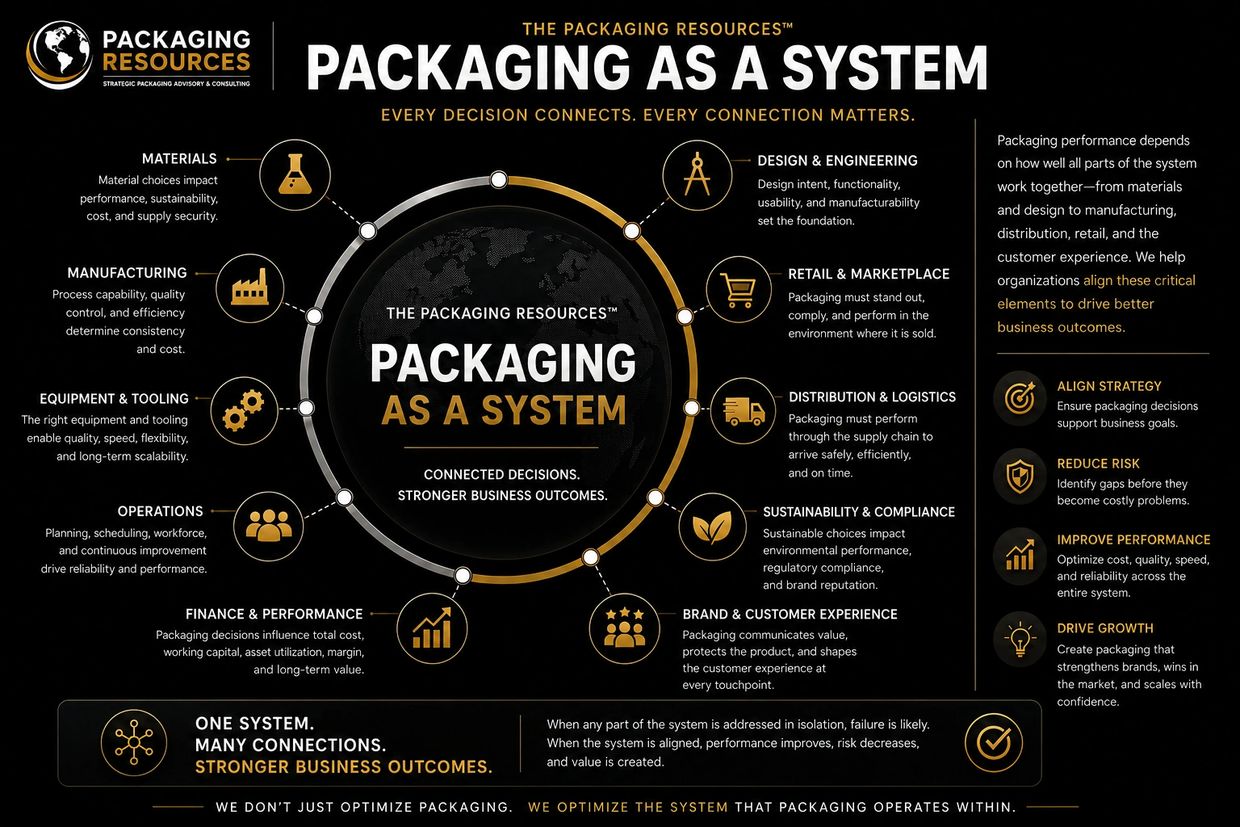
Packaging as a System: A Business Framework for Better Packaging Decisions
Every packaging decision creates consequences across the connected business system.
Why Traditional Packaging Decisions Fail
Opening
For decades, packaging has been approached as a series of independent technical decisions.
Engineering focuses on functionality.
Procurement negotiates material cost.
Manufacturing optimizes production efficiency.
Marketing emphasizes shelf impact.
Supply chain seeks transportation savings.
Finance evaluates return on investment.
Each department makes rational decisions based on its own objectives.
Yet organizations continue to experience avoidable delays, operational inefficiencies, commercialization failures, unexpected costs, and disappointing financial performance.
The problem is rarely the individual decision.
The problem is that those decisions are made independently rather than as part of one connected business system.
The Hidden Cost of Fragmented Decision Making
When packaging is evaluated in isolation, organizations often create unintended consequences elsewhere.
A material change that reduces procurement cost may increase production downtime.
A package optimized for manufacturing may increase transportation costs.
A retail-ready package may complicate automation.
An equipment investment may solve one bottleneck while creating another.
Viewed independently, each decision appears reasonable.
Viewed as a system, the weaknesses become obvious.
This is Why the Framework Exists
The Packaging Resources™ Systems Framework was developed to help organizations evaluate packaging decisions as interconnected business decisions rather than isolated technical activities.
Instead of optimizing one department at a time, the framework evaluates how every packaging decision influences manufacturing, operations, supply chain performance, commercialization, customer experience, financial outcomes, and long-term enterprise value.
Better systems produce better decisions.
Better decisions produce better business performance.
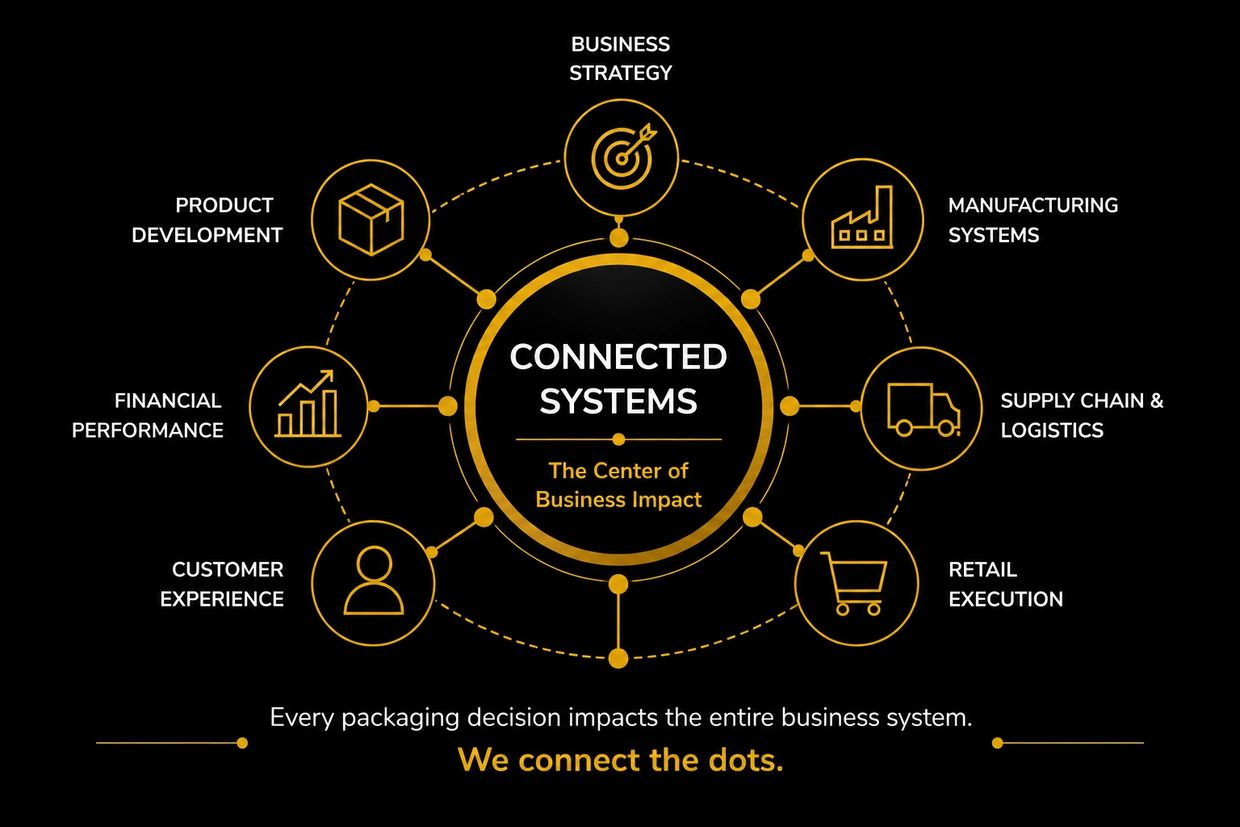
The Eight Connected Business Systems
Opening
The Packaging Resources™ Systems Framework recognizes that packaging decisions extend far beyond package design or manufacturing.
Every significant packaging decision influences multiple interconnected business systems. Optimizing one area without understanding its impact on the others often creates unintended operational, financial, or strategic consequences.
The framework evaluates packaging decisions across eight connected business systems that collectively determine long-term business performance.
Business Strategy
Every packaging decision should support broader business objectives, including growth, profitability, market positioning, customer experience, sustainability, and long-term competitive advantage.
Packaging should never be managed independently from business strategy.
Product Development
Packaging development influences commercialization, manufacturability, product protection, regulatory compliance, branding, and speed to market.
Early packaging decisions often determine downstream operational success.
Manufacturing Systems
Packaging must function within real manufacturing environments.
Equipment capability, production speed, labor efficiency, quality systems, automation, maintenance, and scalability all influence long-term packaging performance.
Supply Chain & Distribution
Packaging affects warehousing, transportation, palletization, inventory management, fulfillment, damage rates, reverse logistics, and distribution cost.
Supply chain performance begins long before products leave the manufacturing line.
Retail & Customer Experience
Packaging communicates brand value while supporting merchandising, shelf presentation, handling, e-commerce fulfillment, usability, and the overall customer experience.
Packaging influences both purchasing decisions and long-term customer satisfaction.
Sustainability & Compliance
Environmental objectives, regulatory requirements, material selection, recycling, product stewardship, and emerging legislation must be balanced with operational realities and financial performance.
Sustainability succeeds when it is integrated into the entire packaging system.
Financial Performance
Packaging decisions influence capital investment, operating cost, labor efficiency, transportation expense, inventory performance, waste reduction, profitability, and enterprise value.
Packaging should be evaluated as a business investment rather than simply an operating expense.
Executive Decision Making
Ultimately, every packaging decision becomes a leadership decision.
Executives must balance competing priorities across manufacturing, operations, finance, customer experience, sustainability, commercialization, and long-term strategic growth.
The Packaging Resources™ Systems Framework provides a structured methodology for making those decisions with greater confidence and a more complete understanding of their business impact.
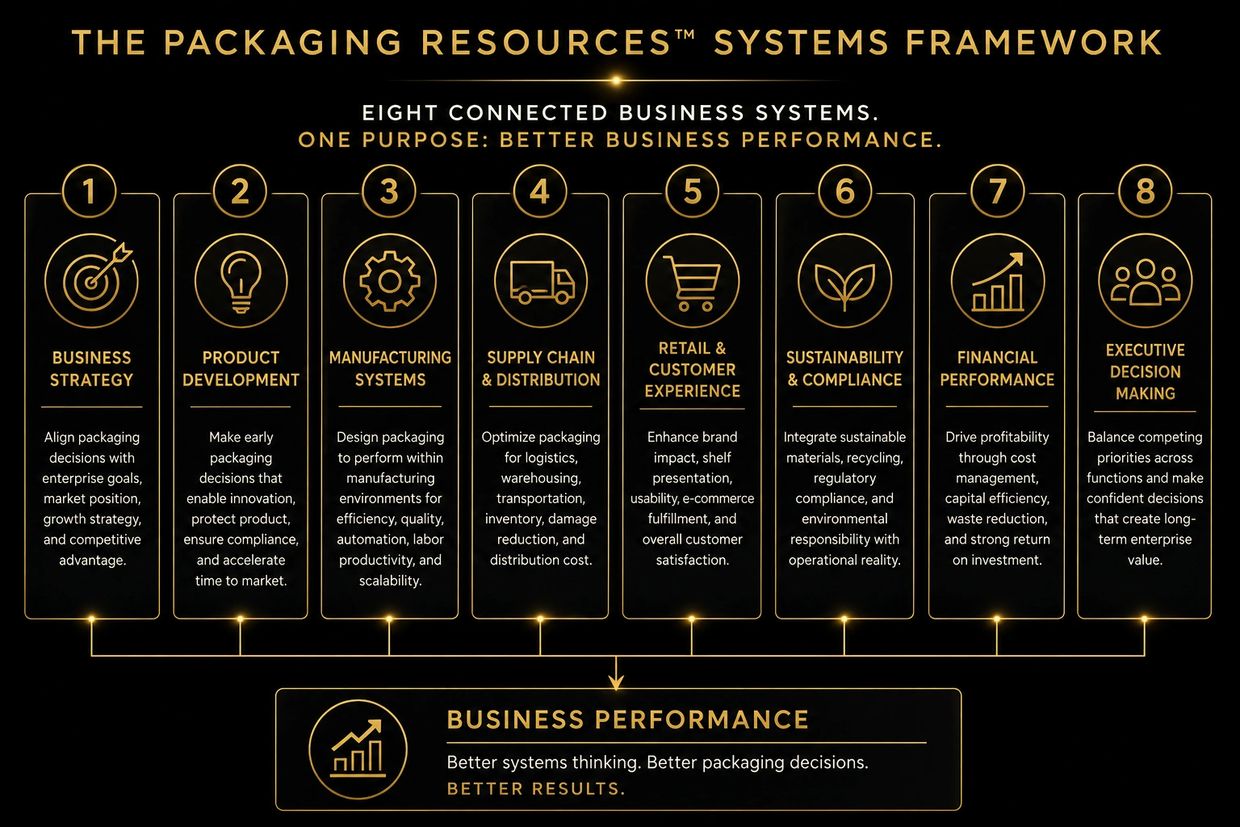
The Packaging Resources™ Systems Framework
Packaging decisions rarely affect just one department. The Framework helps leadership teams evaluate how decisions in one area influence performance across the entire business system.
How the Framework Works
The Packaging Resources™ Systems Framework provides a structured methodology for evaluating packaging decisions before significant investments are made.
Rather than focusing on a single package, supplier, material, or manufacturing issue, the Framework evaluates how every decision influences the broader business system. This process helps leadership teams identify risks, understand trade-offs, and make decisions that improve long-term business performance.
Step 1 – Define the Business Objective
Every engagement begins by identifying the business objective rather than the packaging solution.
The objective may involve commercialization, manufacturing improvement, cost reduction, sustainability, capital investment, acquisition support, operational performance, or long-term growth.
The Framework begins with why the decision is being made.
Step 2 – Identify the Connected Business Systems
Once the objective is understood, the Framework identifies which of the eight connected business systems will be influenced by the decision.
This prevents organizations from optimizing one department while unintentionally creating problems elsewhere.
Step 3 – Evaluate Cross-System Impacts
Each potential decision is evaluated across manufacturing, operations, supply chain, customer experience, sustainability, financial performance, and executive objectives.
This reveals interactions that traditional packaging evaluations often overlook.
Step 4 – Identify Risks and Trade-Offs
Every packaging decision creates trade-offs.
The Framework helps leadership teams understand operational, financial, commercial, regulatory, and implementation risks before significant resources are committed.
Step 5 – Develop Integrated Recommendations
Recommendations are developed to optimize the overall business system rather than individual departments.
The objective is to improve business performance, not simply packaging performance.
Step 6 – Validate Outcomes
Implementation is measured against the original business objectives to confirm that operational, financial, and strategic improvements have been achieved.
Continuous learning strengthens future decision-making and supports long-term organizational performance.
Executive Questions the Framework Helps Answer
The Packaging Resources™ Systems Framework was developed to answer the questions that matter most to executive leadership—not simply packaging engineers or procurement teams.
Rather than beginning with a packaging solution, the Framework begins with the business decision that must be made.
Typical executive questions include:
- Should we redesign our packaging system or optimize what we already have?
- Should we invest in new manufacturing equipment or improve existing capacity?
- Is outsourcing the right strategy, or should we expand internal capabilities?
- Should we standardize packaging across multiple facilities or brands?
- Will this packaging decision improve long-term profitability or simply reduce short-term cost?
- How will this decision affect manufacturing, logistics, retail execution, customer experience, and financial performance?
- What packaging risks should be identified before committing capital?
- How should packaging be evaluated during acquisitions, mergers, or due diligence?
- Where are the hidden operational risks that traditional packaging evaluations often overlook?
- What decision creates the greatest long-term business value?
Closing
These are not packaging questions.
They are business questions.
The Packaging Resources™ Systems Framework helps leadership teams answer them with greater clarity, broader perspective, and a more complete understanding of how packaging decisions influence enterprise performance.
Where the Framework Creates Value
The Packaging Resources™ Systems Framework helps leadership teams improve business performance by identifying how packaging decisions influence connected business systems—not just the package itself.
Rather than optimizing individual departments independently, the Framework evaluates opportunities across the organization to produce measurable operational, financial, and strategic results.
Manufacturing Performance
The Framework helps organizations improve:
• Production throughput
• Equipment utilization
• Labor efficiency
• Quality and consistency
• Automation readiness
• Operational scalability
By evaluating packaging within the complete manufacturing system, organizations often discover opportunities that would otherwise remain hidden.
Commercialization
The Framework helps reduce commercialization risk through:
• Earlier validation
• Faster product launches
• Fewer redesign cycles
• Better cross-functional alignment
• Improved launch readiness
• Reduced implementation risk
Successful commercialization depends on decisions made long before production begins.
Supply Chain Performance
The Framework evaluates packaging's impact on:
• Warehousing
• Transportation
• Inventory management
• Distribution efficiency
• Damage reduction
• Logistics cost
Supply chain performance begins with packaging decisions made during product development—not after products leave the factory.
Customer Experience
Packaging directly influences:
• Retail execution
• Shelf presentation
• Consumer usability
• Product protection
• Brand perception
• Customer satisfaction
Customer experience is created throughout the entire packaging system—not just at the point of purchase.
Financial Performance
The Framework supports stronger financial decision-making by improving:
• Return on investment
• Capital planning
• Operating cost
• Working capital
• Asset utilization
• Long-term enterprise value
Packaging should be evaluated as a business investment—not simply a packaging expense.
Executive Decision Making
The Framework gives leadership teams greater confidence when evaluating:
• Capital investments
• Manufacturing expansion
• Supplier strategy
• Automation initiatives
• Acquisition opportunities
• Long-term operational planning
When leaders understand how packaging decisions influence the entire business system, they make stronger strategic decisions with lower risk.
Better packaging decisions are ultimately measured by business performance.
The Packaging Resources™ Systems Framework helps organizations connect operational decisions to measurable business outcomes—creating stronger performance across the enterprise.
Representative Applications
The Packaging Resources™ Systems Framework can be applied wherever packaging decisions influence operational performance, commercialization, customer experience, or enterprise value.
Rather than focusing on individual packaging components, the Framework evaluates how decisions affect the connected business system.
New Product Development
Align package development with commercialization objectives before engineering resources are committed.
Typical applications include:
• New product launches
• Package architecture
• Material selection
• Commercialization planning
• Cross-functional design reviews
Manufacturing Performance
Evaluate packaging as an operating system rather than simply production equipment.
Typical applications include:
• Manufacturing efficiency
• Automation strategy
• Production line optimization
• Quality improvement
• Labor productivity
• Capital equipment planning
Supply Chain & Distribution
Improve total supply chain performance by understanding how packaging decisions affect logistics, warehousing, transportation, inventory, and fulfillment.
Typical applications include:
• Distribution optimization
• Warehouse efficiency
• Transportation cost reduction
• Inventory performance
• Damage reduction
• E-commerce fulfillment
Retail & Customer Experience
Evaluate packaging through the complete customer journey—from shelf presentation through purchase, delivery, and end-user experience.
Typical applications include:
• Retail execution
• Shelf performance
• Consumer usability
• Customer experience
• Brand presentation
• Retail compliance
Capital Investment & Executive Decision Making
Support leadership teams evaluating major strategic packaging investments.
Typical applications include:
• Capital planning
• Manufacturing expansion
• Automation investments
• Supplier strategy
• Packaging standardization
• Long-term operating strategy
Private Equity, Due Diligence & Transactions
Evaluate packaging as a contributor to enterprise value before acquisitions, mergers, or major investments.
Typical applications include:
• Operational due diligence
• Acquisition integration
• Platform evaluations
• Investment risk assessment
• Growth planning
• Enterprise value improvement
Packaging Assessments
Provide independent executive-level evaluations of existing packaging systems.
Typical applications include:
• Packaging audits
• Manufacturing assessments
• Operational reviews
• Commercialization assessments
• Executive advisory engagements
• Strategic packaging roadmaps
Closing
Although these applications span different industries and business objectives, they are evaluated using the same Systems Framework.
The questions change.
The industries change.
The business system remains connected.
The Framework in Practice
Introduction
The Packaging Resources™ Systems Framework has been applied across thousands of packaging decisions involving manufacturers, consumer brands, retailers, foodservice companies, contract packaging organizations, and private equity investors.
While every engagement is different, the objective remains the same:
Improve business performance by understanding how packaging decisions influence the entire operating system.
Example Applications
Commercialization
Helping organizations reduce launch risk while accelerating time to market.
Manufacturing
Improving throughput, labor efficiency, automation readiness, and operating performance.
Retail
Improving shelf execution, merchandising performance, package usability, and customer experience.
Supply Chain
Reducing logistics cost, transportation damage, inventory complexity, and distribution inefficiencies.
Capital Investment
Evaluating manufacturing expansion, automation investments, supplier strategy, and operational risk.
Private Equity
Supporting operational due diligence, acquisition integration, platform evaluations, and value creation planning.
Executive Advisory
Helping leadership teams make high-impact packaging decisions involving multiple business functions and competing priorities.
Closing
Regardless of industry, organization size, or business objective, the Framework provides leadership teams with a consistent way to evaluate complex packaging decisions through a broader operational and financial perspective.
Better systems thinking leads to better packaging decisions.
Better packaging decisions lead to better business performance.
Better Packaging Decisions Begin with Better Systems Thinking
Packaging decisions influence far more than product appearance or manufacturing efficiency.
They shape commercialization, supply chain performance, capital investment, customer experience, operational execution, and ultimately long-term business performance.
The Packaging Resources™ Systems Framework provides leadership teams with a structured methodology for evaluating these decisions as one connected business system rather than a series of isolated technical activities.
When organizations understand those connections, they make better decisions.
Better decisions reduce risk.
Better decisions improve performance.
Better decisions create long-term business value.
Learn more about the philosophy behind our Framework by reading "Why Packaging Is a Business System."
Start the Conversation
Whether you're evaluating a new packaging platform, improving manufacturing performance, supporting a major commercialization initiative, assessing an acquisition, or simply seeking an experienced independent perspective, we'd welcome the opportunity to discuss your objectives.
Every engagement begins with a confidential advisory conversation focused on understanding your business—not selling consulting services.
If we believe the Packaging Resources™ Systems Framework can help your organization make better decisions, we'll explain how.
If we're not the right fit, we'll tell you.
The Packaging Resources™ Systems Framework is a proprietary methodology developed through more than four decades of experience advising manufacturers, consumer brands, retailers, contract packagers, foodservice organizations, and investors on complex packaging decisions.
Institutional and portfolio-level advisory is provided through The Consultancy LLC.-LEARN MORE
Copyright © 2026 Packaging Resources - All Rights Reserved.
PACKAGING RESOURCES is a division of THE CONSULTANCY, LLC